The Short Version
Yes. In modern dairy systems, every cow used for milk either dies on farm or is eventually sold for slaughter once her milk no longer covers her costs. She typically leaves the herd around five to six years old, even though dairy cattle are biologically capable of living for around twenty years.
To keep her milk flowing, she gives birth roughly once a year, and about half of those calves are male. In North America, Europe and Australia, most of these male calves enter veal or beef supply chains within days or weeks of birth, often after long transport and individual housing that research links to high disease and mortality.
In the United States, animals from dairy herds contribute between 18 and 24 percent of all commercial beef, with cull cows alone providing about 7 percent and finished dairy steers about 12.6 percent. European analyses estimate that around 40 to 60 percent of beef in the EU comes from dairy-origin animals, and Australian "bobby calves" from dairy herds are typically slaughtered at around five days old or raised for veal.
The dairy industry and the beef and veal industries are not separate systems.
They share the same animals, the same supply chains, and, for each cow, the same end.
18–24% of US beef comes from dairy cattle5–6 years average age at slaughter vs. a 20-year lifespan~50% of dairy calves are male, with no role in milk production
Do cows used for dairy get slaughtered?
Yes. Every cow in commercial dairy production is eventually slaughtered — not as an exception, but as the standard economic endpoint of the system.
Take one black-and-white cow in a barn in Wisconsin, Bavaria or Victoria. She stands in a line of other cows used for milk, her production logged in software, her future calculated in kilograms and litres.
As long as her daily milk yield stays above the threshold of profitability, she remains in the milking herd. When it drops below that line, or when her health and reproduction no longer fit the farm's targets, she is "culled". Removed from the herd and sold for slaughter.
Dairy science describes "culling" as the permanent removal of a cow from the herd by sale, slaughter or death, driven mainly by economic decisions rather than by age alone. There is no retirement scheme built into commercial dairy; the system assumes that when she no longer pays, she leaves.
Across high-producing dairy regions, the average cow used for milk spends around three years in production after her first calving and exits the herd at around five to six years of age. Her natural life expectancy, in the absence of intensive production and early culling, is around twenty years.
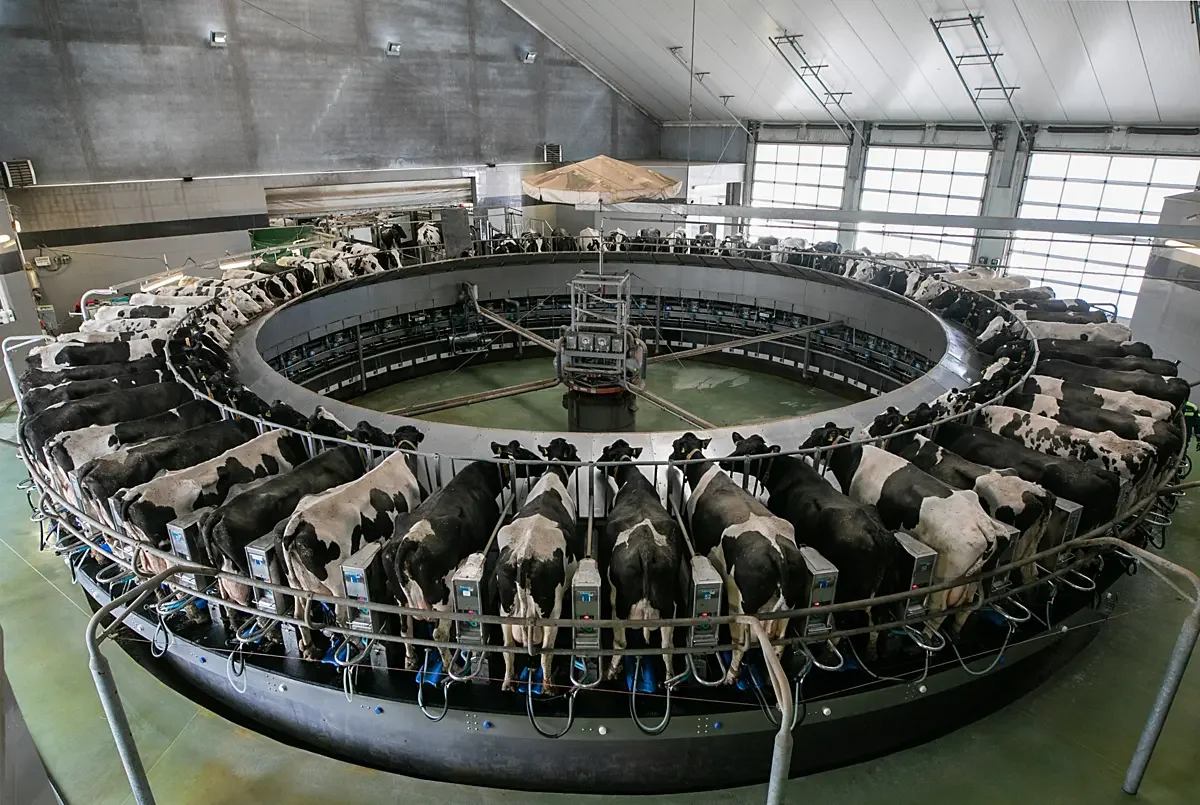
Cows in a commercial milk barn.
Why does the system slaughter her?
The documented reasons are low milk yield, reproductive failure, mastitis and lameness. But these are symptoms of a system built for output rather than longevity, not independent causes.
High-yielding cows used for dairy are bred and managed to produce large volumes of milk, often far above what their bodies evolved to sustain over many years. The result is a predictable pattern: as her body weakens under repeated pregnancies, heavy udders and hard flooring, her risk of mastitis, metabolic disease and lameness rises, and her production dips.
In the United States and other intensive dairy regions, around one quarter to one third of cows in a herd leave each year through culling or death, keeping the average age low and the average yield high. A cow who produces less than she costs becomes an economic loss, and the simplest way to recover some of that loss is to send her to slaughter as a cull cow.
These patterns are not unique to the US. Studies from the Netherlands and other European countries show average total lifespans of around 5.5 years in dairy herds, again far below the natural twenty-year potential and driven mainly by economic culling decisions.
Why are cows from dairy farms culled?
Most common culling reasons (US and EU data): Low milk productionReproductive failureMastitis (udder infection)LamenessMetabolic disease
These are predictable outcomes of a system designed for maximum output — not individual failures.How much beef comes from cows used for dairy?
More than most people buying dairy products know and in some countries, more than most people buying beef know either. Most of it ends up in ground beef with no label to trace it back.
In the United States, the Beef Checkoff's own analysis reports that animals from dairy herds contribute between 18 and 24 percent of the total commercial beef supply, depending on the year. Finished dairy steers alone contribute about 12.6 percent, and cull cows from dairy farms about 7 percent of US beef.
A separate review of cull cows from dairy farms estimates that meat from these cows accounts for almost 10 percent of US commercial beef, with more than three million cows used for dairy slaughtered annually. Most of this meat goes into ground beef and processed products, not premium steaks with a distinct label.
In Europe, policy briefings note that roughly two-thirds of the EU cow herd is of dairy type and that changes in dairy herds directly affect beef supply. One analysis estimates that about 41.5 percent of beef produced in 2023 came from dairy-origin animals; another suggests that dairy herds supply around 60 percent of beef consumed in Europe when all dairy-linked systems are counted.
When you eat ground beef in a fast-food burger or buy mince in a supermarket, the meat can come from a cow used for dairy, a beef steer, a dairy-beef crossbred animal, or a mix of all three.
The label does not say whose body you are eating.
How much beef comes from dairy cattle?
United States: 18–24% of all commercial beef [Beef Checkoff] European Union: ~40–60% of beef [EAAP / Farm-Europe] Australia: Significant; bobby calves are slaughtered at 5 days old [RSPCA Australia] 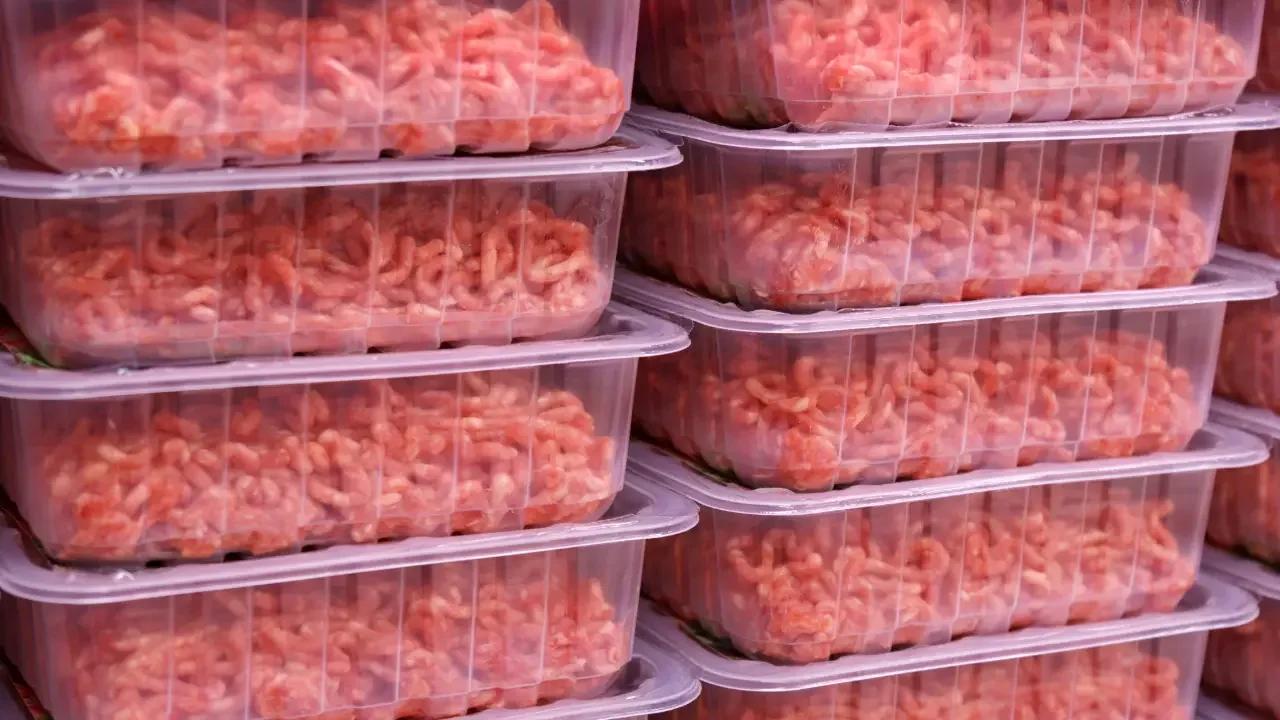
Ground beef at a supermarket counter — with no label indicating whether it came from a dairy herd.
What happens to her male calves?
Most are raised for veal or beef. They cannot produce milk and the industry treats them as surplus from birth — described in the scientific literature as a "low-value by-product of the dairy industry."
For her body to produce milk, she must keep giving birth. On many farms, that means one calf each year, created by artificial insemination and recorded as another data point in the herd-management software.
Roughly half of those calves are male. They cannot produce milk and, unless they are used for breeding or for specific crossbreeding programs, they have no role in replacing the milking herd.
In the United States and Canada, researchers describe three main paths for these calves.
Some are killed as "bob veal" within the first few weeks of life; others are raised as "special-fed" or "formula-fed" veal and slaughtered at around five months; the rest enter dairy-beef systems and are slaughtered around 12 to 14 months.
Along the way, many of these calves are taken from their mothers within hours of birth, receive inadequate colostrum or nutrition, are transported long distances (sometimes more than 24 hours under older US rules), and are traded through auctions where calves from many farms mix. By the time they arrive at calf-raising facilities, studies report high rates of dehydration, failure of passive immunity and disease.
A survey of Canadian dairy farmers found that about 5 percent reported euthanizing at least one male calf on farm shortly after birth, typically when no market exists for him. Some of these calves are killed using methods that do not meet current welfare standards, which the authors describe as an ethical concern for the industry itself.
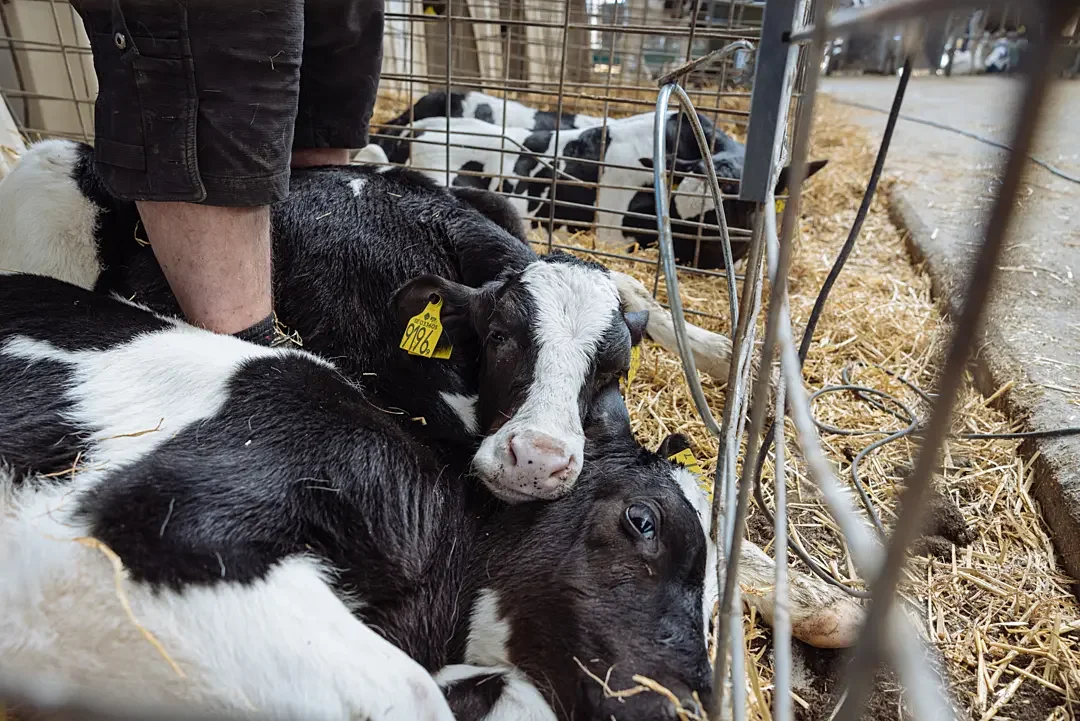
A newborn male calf , considered surplus in the commercial dairy system.
In Europe, surplus calves from dairy herds are commonly transported at around two weeks of age to specialised veal farms and raised until roughly six months. In Australia, "bobby calves" from dairy herds are often taken from their mothers within 12 to 24 hours and sent to slaughter at around five days old.
Every time she gives birth, her male calf steps into one of these paths. Not because of a single farmer's choice, but because the economics of dairy leave him no place in the milking herd.
Is veal a byproduct of dairy?
Veal is not a separate industry with its own breeding herds.
In North America, Europe and Australia, veal calves are overwhelmingly surplus male calves born to cows used for dairy.
Without dairy, there is no continuous stream of male calves with no place in the milking herd. Veal production depends on this stream.
In the United States and Canada, surplus calf reviews describe how neonate calves move from dairy farms to auction markets, dealers and calf-raising facilities where they are raised as bob veal or special-fed veal, typically under intensive indoor conditions. The same reviews highlight "high levels of mortality and morbidity" among these calves, linked to long transport, mixing from multiple sources, low nutrition and limited opportunity to express natural behaviours.
In Europe, calves from dairy herds supply veal systems where they are often housed indoors, fed controlled diets and slaughtered around six months. In Australia, RSPCA materials describe bobby calves as "low-value" animals whose main destinies are slaughter at around five days old or rearing for veal or beef.
When you see veal on a menu or in a supermarket, you are seeing the other side of a dairy birth. The calf on the plate is almost always the male child of a cow used for milk.
Does buying dairy mean buying beef too?
Economically, yes. The same cow who fills cartons of milk also supplies ground beef when she is culled, and her male calves feed veal and beef markets from birth. The two industries are one system dressed as two products.
Standing in the dairy aisle, it feels as if you are choosing between milk brands, not between meat systems. The labels are not designed to connect those dots.
In the United States, the Beef Checkoff — funded by beef producers — presents dairy's contribution to the beef supply as a success story, highlighting how "dairy and beef work together" to create a steady beef marketplace. In Europe, policy papers treat "the cattle sector" as a single integrated system in which dairy herds are a major source of beef and changes in dairy policy ripple into beef availability and price.
Canada's updated Code of Practice for dairy cattle assumes that surplus calves and cull cows remain part of the meat supply and focuses on how, not whether, they are managed and killed. Australia's bobby calf guidelines address the welfare of calves destined for slaughter precisely because their early deaths are embedded in standard dairy practice.
“Dairy and beef work together to create a successful beef marketplace.”
For a full breakdown of how dairy and meat production are connected: the economics, the supply chain, and what happens at every stage read our Meat and Dairy Connection page.
What can you do instead?
This is not your fault.
If you buy dairy, you are responding to years of marketing and labels that present milk, yoghurt and cheese as separate from meat, or even as kinder choices.
Going dairy-free means stepping out of this particular system. It means choosing products that do not require a cow's body to produce milk or a male calf to be sold as a by-product.
Plant-based milks now cover most everyday uses: drinking, cooking, baking, coffee, yoghurt and cream, across markets in North America, Europe, the UK and Australia. Plant-based cheeses, creams and ice-creams are not identical to dairy for everyone, but they offer ways to keep the rituals while changing the supply chain behind them.
Going dairy-free means stepping out of this particular system. It means choosing products that do not require a cow to be bred for milk production, her male calves to be sold as surplus, or her body to be slaughtered when she stops being profitable. The cows in the system today did not choose to be there. The cows who will never be bred into it — because demand shifted — never have to.
Start here:
→ Replace dairy milk in coffee and cooking first
→ Explore oat, soy, almond, or pea milk for drinking and baking
→ Check dairy-truth.com/dairy-free-alternatives for product guides
→ Read our full Meat and Dairy Connection page-
Beef Checkoff — Beef x Dairy: Dairy’s Impact on the Beef Supply (2022). https://www.beefboard.org/2022/11/01/beef-x-dairy-dairys-impact-on-the-beef-supply/
Moreira, L. C., Rosa, G. J. M., & Schaefer, D. M. — Beef production from cull dairy cows: A review from culling to consumption (2021). Journal of Animal Science, 99(7), skab192. https://pmc.ncbi.nlm.nih.gov/articles/PMC8281100/
Wathes, D. C. et al. — Symposium review: Why revisit dairy cattle productive lifespan? (2020). Journal of Dairy Science, 103(4), 3838–3845. https://www.journalofdairyscience.org/article/S0022-0302(20)30120-X/fulltext
Creutzinger, K. et al. — Perspectives on the Management of Surplus Dairy Calves in the United States and Canada (2021). Frontiers in Veterinary Science, 8, 661453. https://pmc.ncbi.nlm.nih.gov/articles/PMC8076512/
EAAP (European Association for Animal Production) — Dairy-beef calves session materials (2023/2024). https://docs.eaap.org/2024/m221/S18T01.pdf
Farm Europe — Policy briefing: Beef & Dairy Sectors (2018). https://www.farm-europe.eu/travaux/policy-briefing-beef-dairy-sectors-sectorial-strategies-to-secure-economic-dynamism-in-the-eu-cattle-sector/
RSPCA Australia — Welfare of bobby calves destined for slaughter (position paper, latest version). https://kb.rspca.org.au/assets/Downloads/PP-B1-Welfare-of-bobby-calves-destined-for-slaughter.pdf
NFACC (National Farm Animal Care Council) — Code of Practice for the Care and Handling of Dairy Cattle (2023). https://www.nfacc.ca/codes-of-practice/dairy-cattle/code2023