How Bird Flu Hid in a Dairy Cow's Udder for Months
In late 2023, a cow on a Texas Panhandle dairy, let's call her Daisy, stopped eating and started giving thick, yellow milk. For weeks, her illness was treated as ordinary mastitis. Months later, testing confirmed she had bird flu (H5N1) the entire time.
New research explains why nobody suspected it. H5N1 targets a receptor that is dense in mammary tissue and almost absent in the lungs, so the virus took hold in her udder instead of her airways. Pasteurization destroys the virus in milk, but Daisy herself endured weeks of painful, undiagnosed infection first.
Her case reveals something the dairy industry has not had to reckon with before: bird flu in dairy cows can hide inside one of the most common diseases in the industry, mastitis, long enough to spread undetected.
Why Did Nobody Test Dairy Cows for Bird Flu?
Daisy was not dramatic. She did not collapse, and she did not cough. She simply went quiet.
She ate less and gave less milk, and the milk she did give came out thick and wrong. Her farmer saw mastitis, because that is what her body was already speaking through.
Mastitis is one of the most common diseases in dairy cattle, so nothing about her looked unusual at first. Nobody reached for bird flu, because H5N1 in a cow's udder was not yet part of the usual diagnostic picture.
While people waited for her to recover from a routine udder infection, the actual cause of her illness was already moving to the next stall, the next farm, the next state.
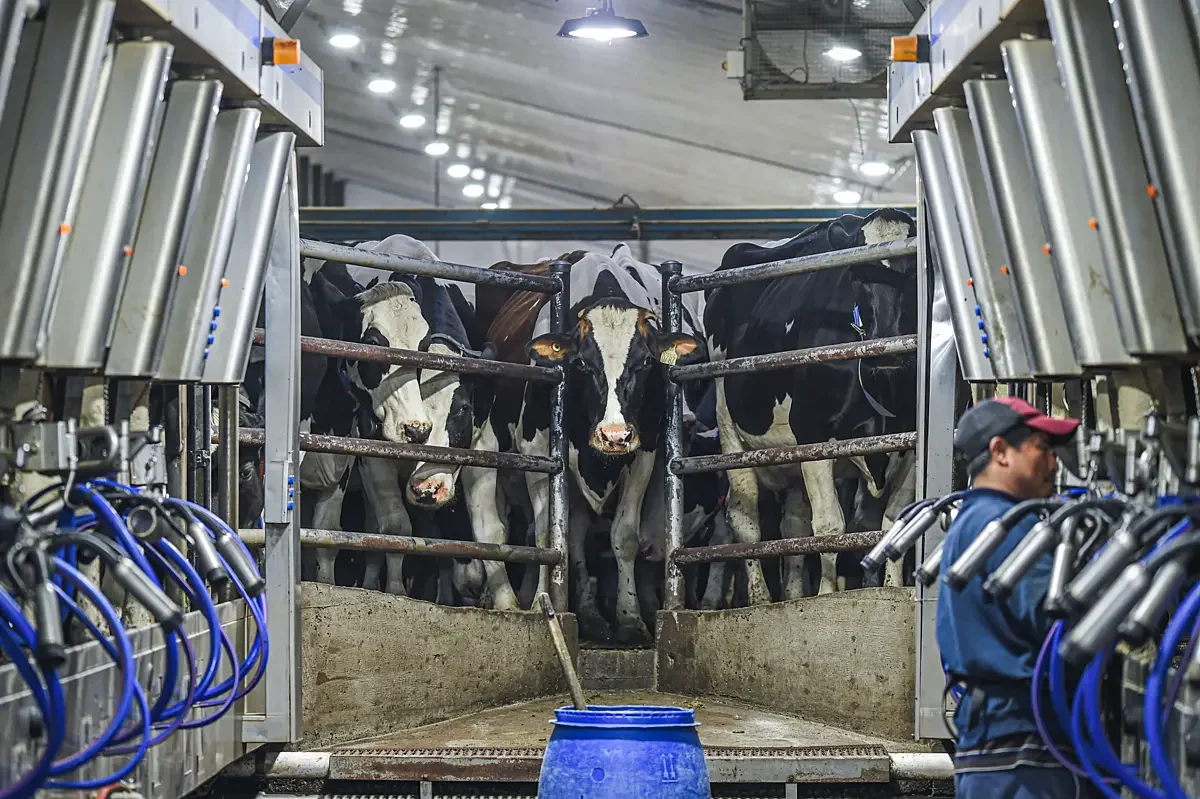
What Was Happening Inside Her Body?
Here is the part that should stop you: Daisy's udder was not collateral damage. It was the target.
Every cell carries molecular locks on its surface, and viruses can only infect cells whose locks they fit. In birds and most mammals, influenza goes for locks concentrated in the lungs, which is why flu usually makes you cough.
A study published in Science Advances found something different in cattle. The receptors H5N1 prefers were packed into mammary tissue and barely present in the respiratory tract.
The virus did not behave like a classic flu. It behaved like an udder disease, turning the organ built to feed her calf into the place it multiplied fastest.
The virus went where the industry had already placed the value: her milk. It attacked the organ we built the business around, the same fluid we diverted from her calf to supermarket shelves.
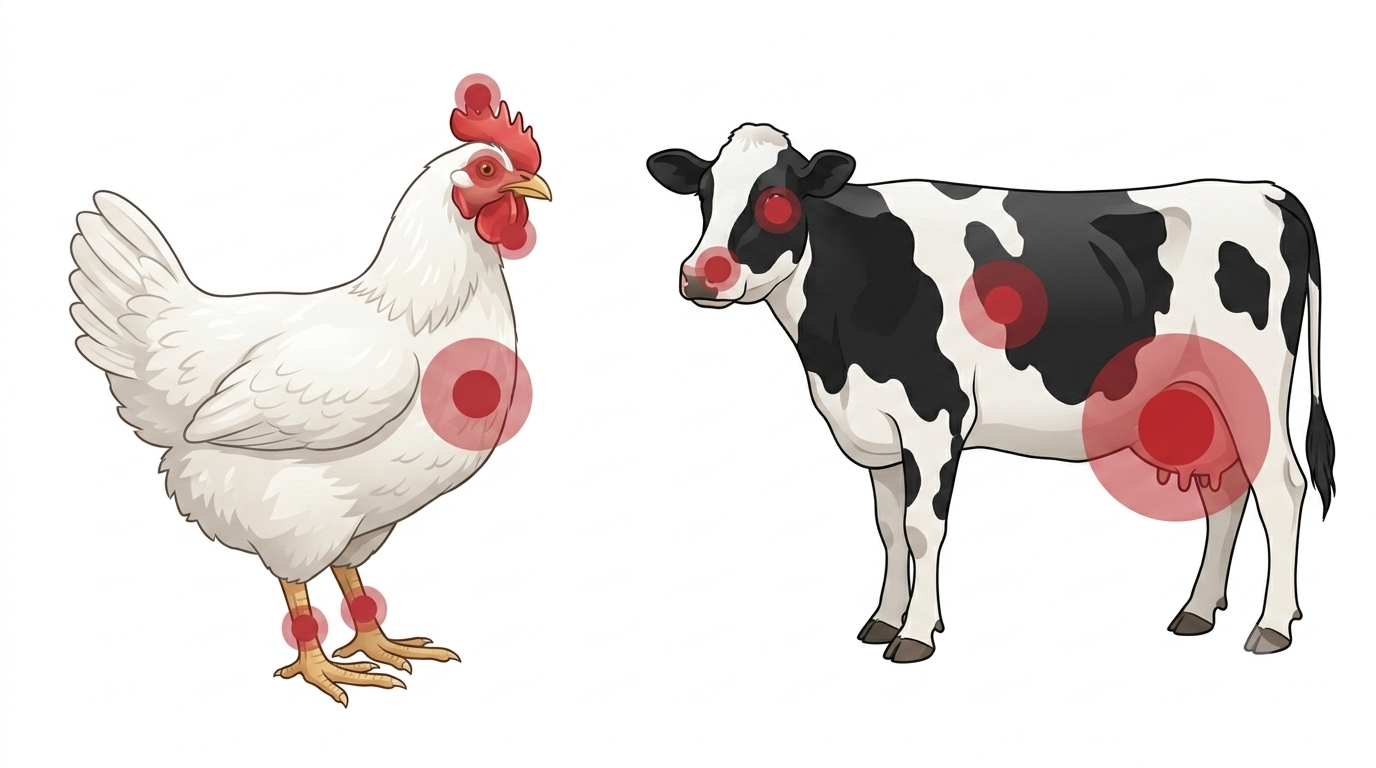
AI generated illustration highlighting the target areas of bird flu in chickens vs cows.
Could Bird Flu Really Hide Inside "Just Mastitis"?
Mastitis causes pain, swelling, and reduced milk quality. It is one of the costliest diseases dairy farms manage. That familiarity is exactly what let this outbreak move undetected for months.
In March 2024, the American Veterinary Medical Association described the symptoms to its members: sudden reduction in feed intake, sharp decrease in milk production, and milk that came out yellow and thick — the appearance of colostrum. Secondary infections included pneumonia and mastitis.
The virus disproportionately affected high-producing lactating cows more than 150 days in milk. Calves, heifers, and dry cows were largely unaffected. The receptor H5N1 prefers is most concentrated in exactly the tissue working hardest to produce milk.
At the time, the AVMA noted:
"Diagnostic labs that have received submissions have not identified an etiology. Investigations are ongoing."
Investigations were ongoing. The virus had been moving between herds for months.
Early cases looked routine, so the warning signs were filed under the wrong disease and the wrong urgency. The virus moved between herds through shared equipment, pooled milk, and cows in transit.
The tragedy is not only that Daisy was sick. It is that her pain became urgent only once it threatened the milk tank.
Is Milk Safe If a Cow Has Bird Flu?
When H5N1 infects the udder, it sheds into milk. That is one reason the virus spread so efficiently within infected herds.
Standard pasteurization temperatures inactivate H5N1 in milk. Studies have found viral fragments in pasteurized milk, but not infectious virus, and animal tests using contaminated pasteurized milk did not produce illness.
Raw milk is different. It can carry live virus, and on affected farms, cats that drank raw milk developed severe disease and often died.
The science is clear on consumer safety. But from Daisy's side of the story, her milk was only judged safe or unsafe after she had already endured the infection.
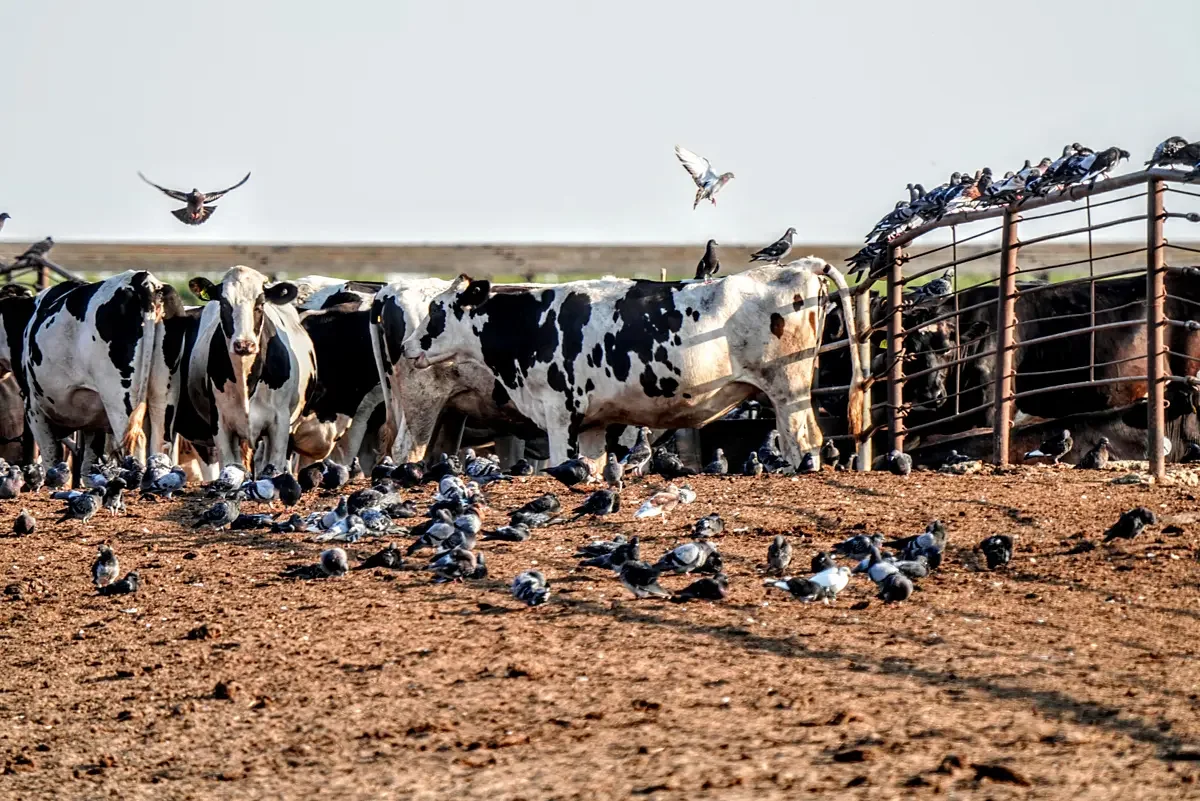
Holstein heifers surrounded by pigeons at a dairy farm. Central Valley, California, USA, 2025.
Source: Crystal Heath / Our Honor / We Animals
Could Bird Flu in Dairy Cows Trigger a Wider Outbreak?
Daisy's illness is not a one-off accident. It is a warning about what happens when one animal's body becomes a high-volume, multi-species production system.
H5N1 has already moved from wild birds into poultry, cows, barn cats, and occasionally humans. Every new host gives the virus more chances to adapt, and scientists now know mammary tissue is one of the places to watch closely.
In California, the picture was worse. Producers had been told to expect a mortality rate of less than 2%. They were seeing 10 to 15 percent of infected cattle dying. In some herds, 50 to 60 percent of animals were affected — five times the 10 percent morbidity initially reported. Susanne Rust at the Los Angeles Times documented the discrepancy as it unfolded.
Her suffering stayed invisible until it became useful as a public-health signal. That is not just a veterinary failure. It is a moral one.
What You Can Do
Every glass of milk requires a cow. Every swap you make is a step outside a system where the next outbreak starts the same way this one did.
Start with your milk. Oat and soy come closest to dairy's protein, and most fortified versions match its calcium. Move to your creamer next, then your cheese. Each swap is small, but each one matters.
This is one outbreak. The pattern repeats. The newsletter is where we report it first. Outbreaks, investigations, and the facts the dairy industry hopes you never find.
She had a name we gave her. She had a story long before we found it.
FAQ
Is pasteurized milk safe during the H5N1 outbreak?
Yes. Standard pasteurization temperatures effectively inactivate H5N1 in milk. Pasteurized milk is the safer choice for consumers, even though viral fragments have occasionally been detected in retail products.
Is raw milk safe if cows have bird flu?
No. Raw milk from infected cows can carry live H5N1 virus. On affected farms, raw milk has been linked to severe illness and death in cats that drank it.
Can humans catch H5N1 from milk?
Pasteurized milk is not considered a realistic route because pasteurization inactivates the virus.
The main concern is raw milk and direct contact with infected cows or contaminated farm environments.
Why did bird flu show up in the udder instead of the lungs?
Because the virus prefers a receptor that is concentrated in mammary tissue and mostly absent from the respiratory tract. That is why cows develop mastitis-like illness rather than the lung-focused disease people usually expect from flu.
What are the symptoms of bird flu in dairy cows?
The American Veterinary Medical Association described them to members in March 2024: sudden reduction in feed intake, sharp drop in milk production, and milk that turns yellow and thick. Secondary infections, including mastitis, are common. Affected cows are typically high-producing animals more than 150 days into lactation.
How deadly is H5N1 for dairy cows?
Early reports suggested a mortality rate below 2 percent. In California, producers reported 10 to 15 percent of infected cattle dying, with some herds seeing 50 to 60 percent of animals affected. The outbreak was significantly more severe than initially communicated.
Why did it take so long to recognize?
Because the symptoms looked like ordinary mastitis, one of the most common diseases in dairy cattle.
The outbreak was only recognized after sequencing and broader investigation showed the cows had H5N1, not a routine bacterial infection.
What does this mean for the future?
It means scientists now have a better clue about where H5N1 can hide, and where it might jump next.
It also means dairy surveillance has to take udder disease more seriously, because a familiar symptom can conceal a very unfamiliar threat.
-
Nature — Spillover of highly pathogenic avian influenza H5N1 virus to dairy cattle (2024). https://www.nature.com/articles/s41586-024-07849-4
Phys.org — How H5N1 bird flu hid unrecognized for weeks in dairy cattle (2026). https://phys.org/news/2026-06-h5n1-bird-flu-hid-unrecognized.html
Bioengineer.org — How H5N1 Bird Flu Went Undetected for Weeks in Dairy Cattle (2026). https://bioengineer.org/how-h5n1-bird-flu-went-undetected-for-weeks-in-dairy-cattle/
PubMed — Receptor basis of unusual tissue tropism of avian influenza H5N1 clade 2.3.4.4b virus in cattle, Science Advances (2026). https://pubmed.ncbi.nlm.nih.gov/42319934/
Scientific American — How Bird Flu Caught the Dairy Industry Off Guard (2025). https://www.scientificamerican.com/article/how-bird-flu-caught-the-dairy-industry-off-guard/
CNN — H5N1 bird flu was circulating in dairy cows for four months before it was detected (2024). https://www.cnn.com/2024/05/02/health/h5n1-bird-flu-usda
Nature Communications — Pasteurisation temperatures effectively inactivate influenza A viruses in milk (2025). https://www.nature.com/articles/s41467-025-56406-8
CIDRAP — More evidence pasteurization inactivates H5N1 avian flu virus in milk (2024). https://www.cidrap.umn.edu/avian-influenza-bird-flu/more-evidence-pasteurization-inactivates-h5n1-avian-flu-virus-milk
PMC — Bovine mastitis: risk factors, therapeutic strategies, and alternatives (2020). https://pmc.ncbi.nlm.nih.gov/articles/PMC7649072/
PMC — Plant-Based Dairy Alternatives Contribute to a Healthy and Sustainable Diet (2023). https://pmc.ncbi.nlm.nih.gov/articles/PMC10421454/
LA Times — “Bird flu is spreading rapidly among California dairy cows. Will milk prices rise?” (2024)